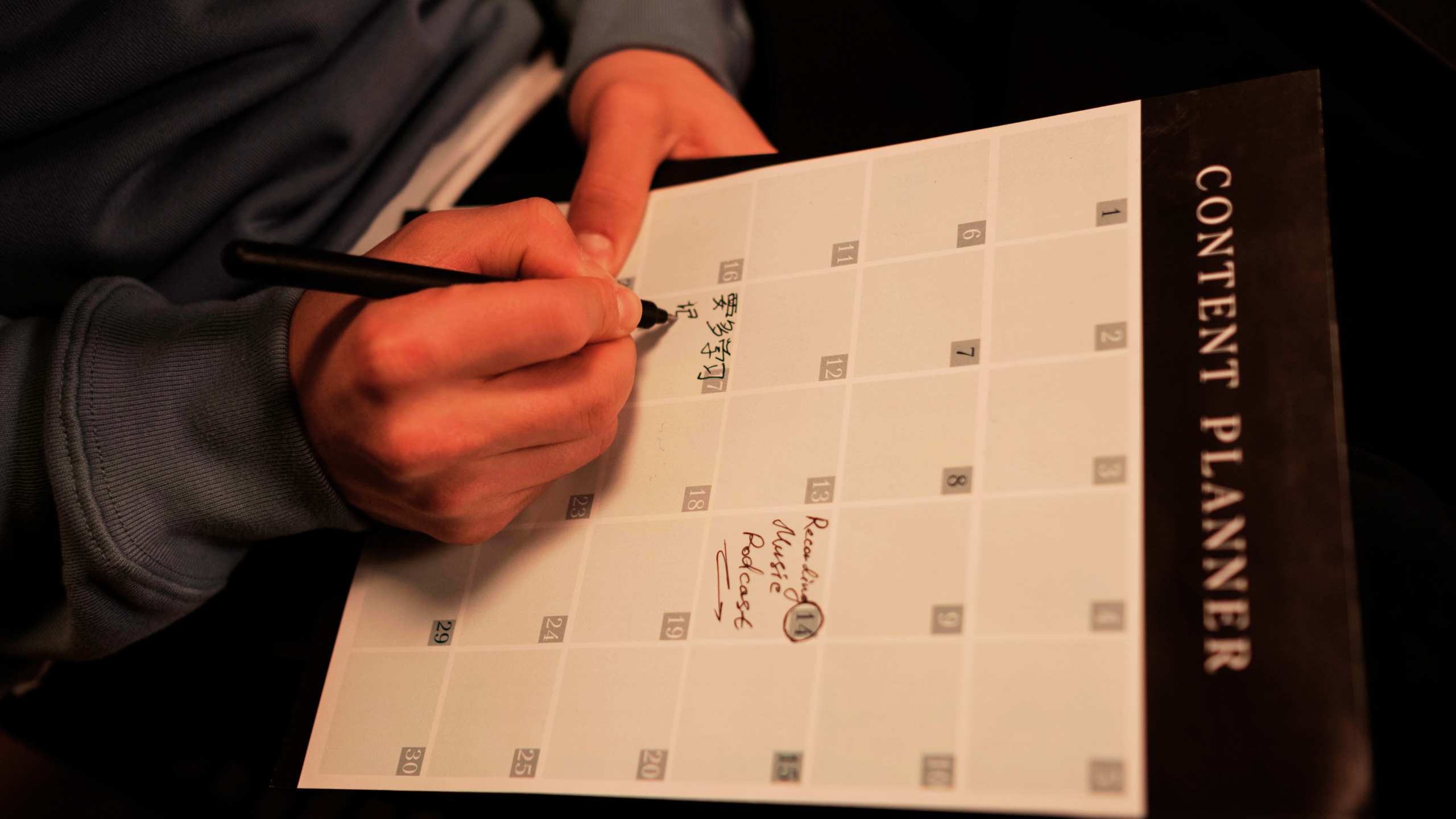
Dear YouTuber,
Most YouTube channels operate on a reactive publishing model: an idea surfaces, a video gets made, a date gets picked based on when production finishes.
The result is a content library with no internal logic, no strategic accumulation, and no compound effect.
A 3-month editorial calendar changes all of this.
This article covers the methodology for building a calendar for your YouTube channel, with the week-by-week logic that helps you achieve your goal.
Why 3 Months Is the Right Planning Horizon
A 3-month horizon is long enough to create strategic content sequences and short enough to remain responsive to performance data.
One month is too short because it doesn’t allow for the kind of topical clustering that builds algorithmic authority.
Six months is too long because the content landscape shifts, performance data makes early assumptions obsolete, and rigidity becomes a creative liability.
Three months maps cleanly onto quarterly business rhythms: advertiser spend cycles (which affect CPM and therefore monetization strategy), seasonal audience behavior shifts, and the minimum timeframe over which YouTube’s recommendation system can register and respond to consistent content signals.
The 3-month calendar also provides the operational stability that allows yout to manage a YouTube channel as a system rather than as a series of individual decisions.
When the next 12 weeks of content are planned in advance, production can be batched, scripts can be developed in parallel, and publishing decisions can be made based on strategy rather than availability.
Phase 1: The Content Audit Before You Plan
Before building a forward-looking calendar, you need a backward-looking analysis.
Pull the last 90 days of video performance data from YouTube Analytics (if you have them).
Identify your top 5 videos by watch time, your top 5 by CTR, your top 5 by subscriber conversion, and your 5 lowest performers by retention.
These four lists tell you the content themes and formats your audience is most and least responsive to. A structured channel audit will surface this data in a format that directly informs planning decisions.
From this audit, extract three outputs:
1- Your proven content clusters: the thematic areas where you have demonstrated strong performance across multiple videos. These are the anchors of your 3-month calendar.
2- Your format distribution: the mix of video types (tutorials, opinion pieces, case studies, lists, documentaries) that has generated the highest combined watch time. This tells you what your audience expects and is willing to commit time to.
3- Your content gaps: topics that appear in your keyword research and competitor analysis but are absent from your existing library. These are the expansion opportunities that feed algorithmic growth beyond your existing audience.
Phase 2: Defining the 3-Month Strategic Objective
An editorial calendar without a strategic objective is a publishing schedule.
Before assigning topics to dates, define what the 3-month block is intended to achieve. The objective must be specific and measurable.
Common 3-month objectives for established channels include:
- increase average view duration from 52% to 62% retention (requires script and structure intervention);
- grow new viewer percentage from 18% to 28% (requires broader topic coverage and SEO-optimized content injection);
- or increase RPM by 30% through niche repositioning toward higher-CPM content categories.
The objective determines the content mix.

A retention objective means the calendar should prioritize long-form, deeply developed content with proven structural retention techniques.
A new viewer objective means the calendar should weight toward SEO-targeted, broadly appealing content on high-search-volume topics.
An RPM objective means the calendar should shift toward content categories that attract premium-CPM advertisers.
Fix one objective per 3-month block. Trying to optimize for retention, growth, and monetization simultaneously produces a calendar that serves none of them well.
Phase 3: Building the Content Mix Architecture
A high-performing 3-month calendar operates on a 3-type content architecture, published in a repeating sequence:
Type 1: Anchor Content (40% of output)
Anchor content is your primary content format, meaning the videos that define the channel’s identity, attract your core audience, and generate the most total watch time.
These are typically your longest, most developed pieces.
They appear in proven topic clusters. They are optimized for retention, not discovery.
Type 2: Discovery Content (40% of output)
Discovery content is designed to attract new viewers.
These are SEO-targeted videos on high-search-volume topics within your niche, shorter than anchor content (typically 8–12 minutes), and optimized for click-through on both YouTube Search and Browse Features.
They expand your audience beyond the existing subscriber base.
Type 3: Conversion Content (20% of output)
Conversion content exists to convert viewers into subscribers, community members, or customers.
These are videos that make a direct case for ongoing engagement: ‘Why this channel exists’, ‘What you get from subscribing’, ‘The content I’m producing over the next 3 months.’
These videos should be less frequent but more deliberately produced.
Phase 4: Topic Selection and Sequencing Logic
Topic selection is where most editorial calendar attempts fail. Topics are chosen based on what seems interesting or timely, not on their strategic relationship to each other. A well-built calendar selects topics based on four sequencing principles.
Principle 1: Topical Clustering
Group related topics into 3–4 week clusters. Within a cluster, each video either deepens a topic introduced in the previous video or approaches the same underlying theme from a different angle.
This builds algorithmic topical authority in a concentrated window and keeps returning viewers engaged with a coherent arc.
For a channel in the YouTube strategy niche, a cluster might cover: week 1 — analytics overview, week 2 — CTR deep dive, week 3 — retention analysis, week 4 — traffic source strategy.
Principle 2: Difficulty Escalation
Within a cluster, sequence topics from accessible to expert-level. The first video in a cluster attracts the broadest audience. Subsequent videos filter toward more engaged, higher-retention viewers.

This produces a viewer journey rather than a collection of standalone pieces — and viewer journey generates the subscriber conversion and loyalty signals that matter most to the algorithm.
Principle 3: Format Variation
Alternate formats across consecutive videos.
If week 1 is a data-driven analysis piece, week 2 should be a case study or tutorial. If week 3 is opinion-led, week 4 should be structured and evidence-based.
Format variation prevents audience fatigue and maximizes the range of viewer intents you’re serving within the same thematic territory.
Principle 4: Internal Link Planning
Map internal link opportunities before locking topics.
Every video in the calendar should have at least two other videos in the same 3-month block that it can reference directly with end screens or cards.
This is a planning requirement.
Videos that don’t link to each other are islands. Videos that form a network generate compound watch time.
Phase 5: The Buffer System — How to Handle Disruption
A 3-month calendar that doesn’t account for production disruption will fail within 3 weeks.
Life interrupts. Production takes longer than expected. A topic becomes irrelevant due to a platform update. A competitor publishes on your planned subject before you do.
Build a buffer of 2–3 fully produced and ready-to-publish videos at all times. These are your emergency reserve.
They allow the calendar to absorb a missed production week without publishing disruption.
Phase 6: KPI Check-Ins — Managing the Calendar in Real Time
A calendar is a plan, not a contract.
It should be reviewed against performance data at weeks 4 and 8, with structural adjustments based on what the data shows.
At week 4 review, compare the CTR and 30-second retention of the first month’s videos against your channel baseline.
If anchor content is underperforming CTR targets by more than 15%, packaging is the likely cause. So, adjust thumbnail and title strategy for the remaining weeks.
If discovery content is underperforming on new viewer percentage, SEO targeting may be off. Then, review keyword selection and title optimization.

On Week 8 review, compare total watch time accumulation against the 3-month objective.
A channel targeting a retention improvement should see a measurable upward trend in the AVD curve by week 8.
A channel targeting new viewer growth should see a 5–10 percentage point increase in new viewer ratio.
If these indicators haven’t moved, the calendar structure needs adjustment before the final month, not at the end of the quarter.
The One-Page Calendar Format That Works
The most functional editorial calendar format for a solo creator or small team is a simple spreadsheet with columns for: week number, publish date, video title (working), content type (anchor/discovery/conversion), target keyword, internal links planned, production status, and notes.
No tool is needed beyond a shared Google Sheet.
Each row is one video. The calendar is sorted by publish date. Status updates as the video moves through production (scripted, recorded, edited, scheduled, published).
When a slot is in ‘scripted’ status 3 weeks before publish date, the production is on track. When it’s in ‘idea’ status 1 week before, the buffer system activates.
This format makes the calendar a living management tool rather than a static document. It is the operational backbone of a channel as a business, not as a creative hobby.
Conclusion
A 3-month editorial calendar is the operational infrastructure that allows creativity to compound.
The result is a channel that grows predictably rather than randomly, where every video is a deliberate move in a planned sequence rather than an isolated piece of content.
The question to answer before planning your next video: does it fit into a calendar, or is it just an idea?
If you need a 3-month editorial calendar built for your specific channel or a channel manager who implements and tracks this system on your behalf, reach out here.
Aona, The Shadow That Makes Your Screen Shine ✨
Disclaimer: this article was AI-generated and reviewed/edited by the site owner before publication.
Laisser un commentaire